
Introduction
In modern infrastructure—especially sports facilities—efficient drainage systems are critical to maintain usability, safety, and performance. One of the most advanced solutions developed for this purpose is the Sub-Air Drainage System.
This system is widely used in cricket stadiums, football grounds, and high-performance landscapes, where even a small amount of waterlogging can disrupt operations. A well-known example in India is the M. Chinnaswamy Stadium, which uses this system to ensure matches resume quickly after rain.
What is a Sub-Air Drainage System?
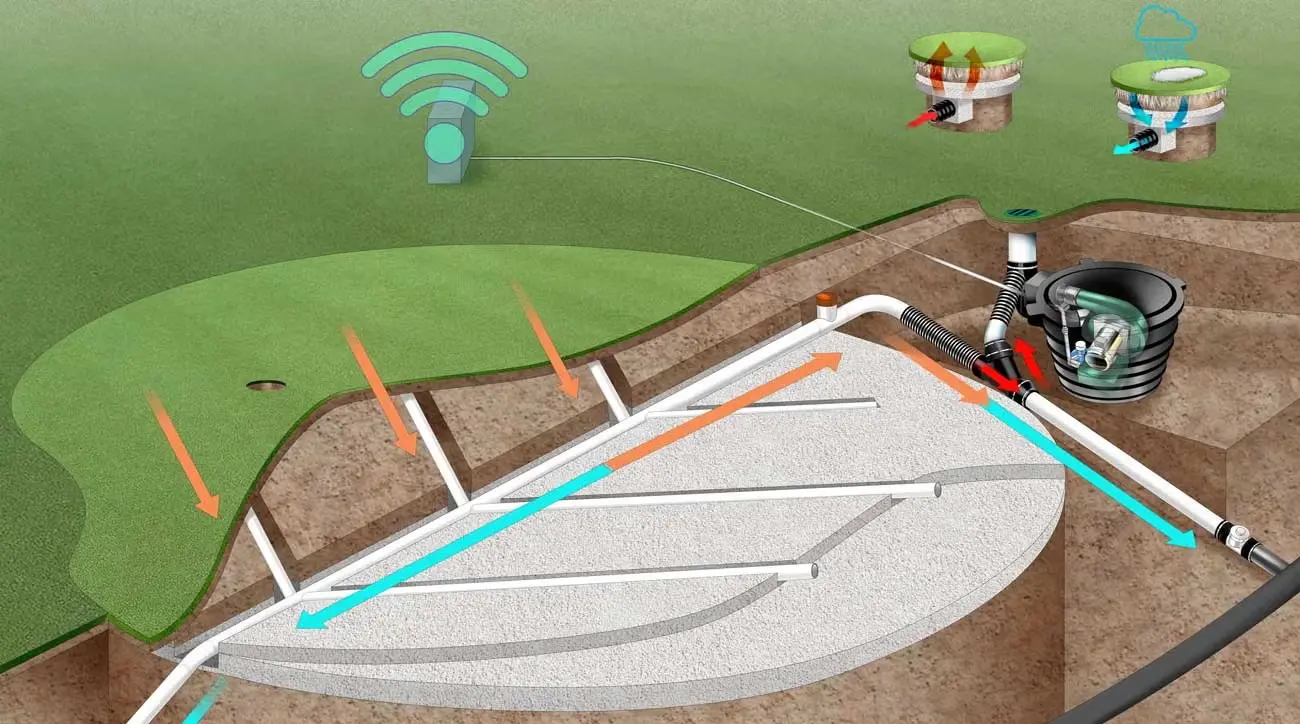
A Sub-Air Drainage System is an advanced underground drainage technology that uses vacuum and air pressure to remove water from the soil rapidly.
Unlike traditional drainage systems that rely only on gravity, this system actively pulls water out of the ground, making it much faster and more efficient.
Why is it Needed?
In conventional drainage:
- Water takes time to percolate through soil
- Drain pipes remove water slowly
- Grounds remain wet for hours
This is a major problem in:
- Cricket stadiums
- Football fields
- Golf courses
- Landscaped areas
The Sub-Air system solves this by accelerating the drainage process.
How Does the Sub-Air Drainage System Work?
The system works on a simple but powerful principle:
Step 1: Underground Drainage Network
Perforated pipes are installed below the ground surface in a grid pattern.
Step 2: Connection to Vacuum System
These pipes are connected to a central vacuum unit or blower system.
Step 3: Suction Mechanism
When activated, the system creates negative pressure (vacuum).
This vacuum:
- Pulls water from soil pores
- Drains water into pipes
- Removes it rapidly from the ground
Step 4: Air Injection (Optional Mode)
The system can also push air into the soil, which helps:
- Dry the surface faster
- Improve aeration
- Maintain turf health
Key Components of the System
- Perforated Drain Pipes
Installed below the playing surface to collect water. - Gravel and Sand Layers
Help in filtration and smooth water movement. - Vacuum Blower Unit
Creates suction to pull water quickly. - Control System
Operates suction or air injection as needed.
Case Example: M. Chinnaswamy Stadium, Bengaluru
The M. Chinnaswamy Stadium is one of the best examples of Sub-Air drainage in India.
What makes it special?
- Uses an advanced Sub-Air system
- Can drain rainwater extremely fast
- Matches can resume within 30–60 minutes after heavy rain
This system has significantly reduced match delays and improved ground management efficiency.
Advantages of Sub-Air Drainage System
1. Very Fast Drainage
Water is removed much faster compared to traditional systems.
2. Reduced Downtime
Sports activities can resume quickly after rainfall.
3. Improved Soil Health
Air injection improves root aeration and turf strength.
4. Better Surface Stability
Prevents waterlogging and maintains ground firmness.
5. Controlled Operation
System can be turned ON/OFF as required.
Applications
Sub-Air drainage systems are used in:
- Cricket stadiums
- Football grounds
- Golf courses
- Race tracks
- High-end landscaping projects
- Industrial areas with waterlogging issues
Comparison with Traditional Drainage
| Feature | Traditional Drainage | Sub-Air Drainage |
| Speed | Slow | Very Fast |
| Method | Gravity-based | Vacuum-assisted |
| Efficiency | Moderate | High |
| Control | Limited | Fully controlled |
| Cost | Lower | Higher (initial) |
Limitations
While highly effective, the system has some challenges:
- Higher initial installation cost
- Requires power for operation
- Needs proper design and maintenance
Conclusion
The Sub-Air Drainage System is a high-performance solution for areas where rapid water removal is critical. By combining engineering design with active suction technology, it ensures that grounds and surfaces remain functional even after heavy rainfall.
The successful implementation at the M. Chinnaswamy Stadium clearly shows how advanced drainage systems can transform infrastructure efficiency.
As infrastructure projects become more performance-driven, adopting such intelligent drainage solutions will be essential for long-term reliability and operational efficiency.